How compromised transaction authority can defeat trusted systems—and what organizations can do to protect irreversible actions.
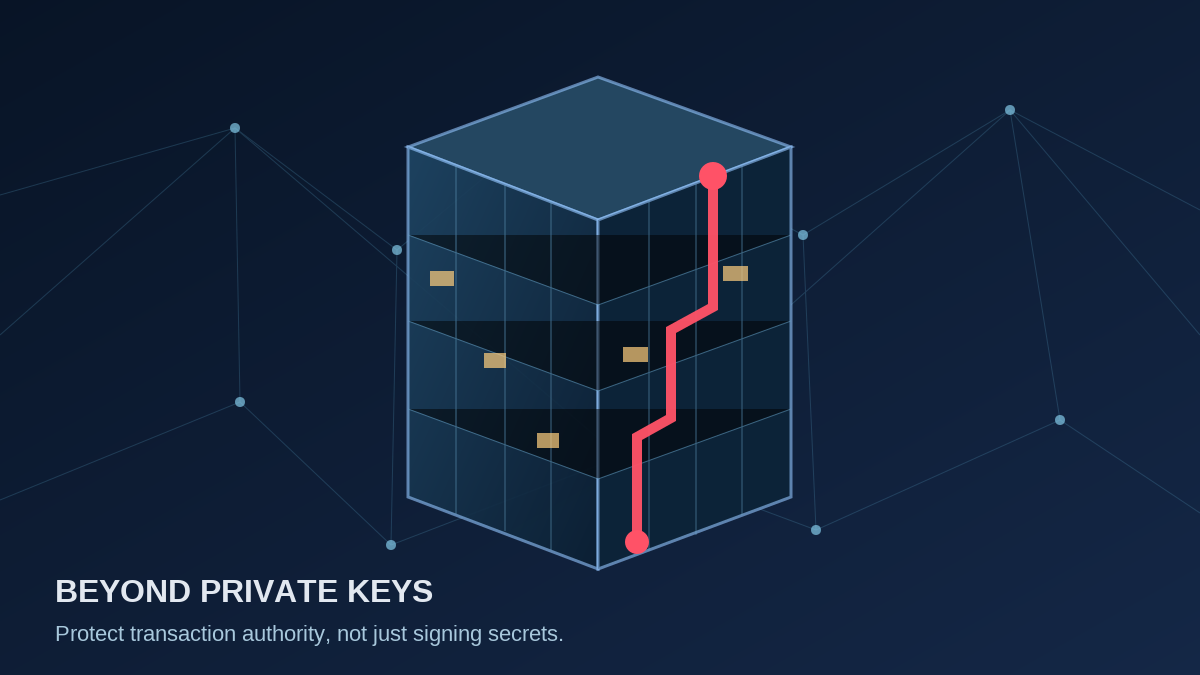
Executive assessment · October 30, 2026. Binance reports approximately $6.3 billion affected by a multi-chain theft. Public records demonstrate valid authorizations for attacker-benefiting transfers, but the precise internal intrusion path remains unresolved. This analysis distinguishes confirmed observations, company statements and architectural inferences.
1. Centralized exchange security is not blockchain security
Binance operates a centralized exchange (CEX): an extensive infrastructure of custody workflows, withdrawal services, employee and workload identities, transaction builders and signing systems. Compromise of that infrastructure is not equivalent to a flaw in Bitcoin's cryptography, Ethereum's consensus, or a decentralized exchange's smart contracts. A decentralized exchange (DEX) has a different threat model, including contract, oracle and interface risk; neither architecture is inherently immune.
The public record describes assets moved on multiple networks through apparently valid authorizations. The key question is how illegitimate intent entered a trusted authorization path—not whether the affected blockchains stopped verifying signatures.
2. What public evidence establishes
Independent analyses by TRM Labs and Elliptic place the impact at approximately $6.36–6.43 billion under different asset and chain-counting methods. Binance estimates about $6.3 billion. These values are time- and methodology-dependent, not settled final loss accounting.
The Ethereum EIP-7702 authorization path
EIP-7702 enables an externally owned account to authorize delegated execution. Investigators found an Ethereum transaction with 50 authorizations spanning consecutive nonce values associated with a Binance wallet. One matching authorization enabled attacker-controlled delegation, followed by large ETH and token transfers. That does not demonstrate a cryptographic defect in the standard: the issue is why such high-risk authorizations could be generated.
Important distinction: A protocol accepting a valid signature does not prove that a transaction was consistent with the account owner's intended business action.
Why the other chains matter
Observed transfers also involved Bitcoin, XRP Ledger, Tron, Solana and other chains. A single Ethereum delegation cannot explain valid withdrawals across those different systems. This supports the inference that attackers could influence a broader transaction-authority environment, but does not reveal which specific upstream component or credentials failed.
Binance's preliminary statement described a possibly compromised DevOps laptop and a withdrawal-capable service container; later updates indicated additional entry points. Binance said it had found no evidence of private-key leakage. None of those statements is equivalent to a complete independently verified forensic reconstruction.
3. Key protection is not intent protection
Hardware security modules (HSMs), multiparty computation (MPC) and multisignature custody remain valuable. They reduce the risk that a single stolen private key can unilaterally authorize transfers. But a protected signer can still faithfully sign an attacker-selected request if the requester, policy or approval context has been compromised.
The February 2025 Bybit theft illustrates a related—but not identical—failure: legitimate signers approved a transaction through a manipulated interface, allowing attacker-benefiting wallet behavior. Binance appears to involve a broader machine/service-driven authorization path; its full root cause is not public.
A valid signature answers who signed. It does not, by itself, answer whether the action was legitimate.
4. Five defensible controls and how to test them
Independent signing-boundary policy
Protect the signer with a separately administered policy decision point. Restrict transaction classes, destinations, chain-specific delegation, upgrades and exceptional account changes. Acceptance test: a compromised withdrawal requester attempts to sign a prohibited EIP-7702 delegation; the signing boundary rejects it despite valid service credentials.
Independent transaction-effect verification
Decode and, where appropriate, simulate chain effects in a component outside the transaction builder's trust domain. Compare those effects against a canonical, approved purpose. Acceptance test: an apparently routine transfer that also changes account control is detected and halted. Unknown high-risk semantics should fail closed, not silently bypass checks.
Aggregate limits and blast-radius controls
Enforce wallet, asset, destination and cross-chain velocity thresholds outside the withdrawal service. Acceptance test: replay a staged multi-chain theft pattern; cross-chain limits stop further authorization before a predefined maximum-loss budget is exceeded. These controls primarily limit damage; they do not always prevent the first bad transaction.
Separation of duties across independent trust domains
Separate infrastructure maintenance, policy administration, transaction approval and signing. Multiple approvers sharing the same compromised interface are not truly independent. Acceptance test: compromise an administrator's session; the attacker still cannot elevate policy and complete a high-value transfer without an independently governed decision.
Independent evidence and response
Preserve immutable records of requester identity, authorization context, policy evaluation, decoded effects, approval and final execution. Acceptance test: reconstruct the full authorization path even when the originating application is assumed compromised. Prepared emergency communications and recovery procedures help after prevention fails.
No public record yet proves that any one of these controls would have stopped the entire Binance operation. Their roles must be distinguished: blocking known primitives, plausible prevention, detection, damage limitation and recovery.
5. The emerging question: who can ultimately cause an irreversible action?
Conventional access reviews usually examine privileges within one domain. Real operational authority can be composed across many domains: developer endpoint → cloud role → workload identity → withdrawal API → signer. Each individual permission might look ordinary while their combination creates a route to catastrophic action.
At Quantum Shield Labs, we are investigating a Privileged Authority Graph concept: evidence-driven mapping of how humans, services, containers, cloud identities, APIs and AI agents can indirectly obtain consequential operational authority. An effective approach must distinguish read access from the capacity to initiate irreversible effects, account for conditional policies and explain uncertainties. This is a research direction, not a released QSL product or a claim that we could have prevented Binance.
6. Why this matters to AI agents
AI agents increasingly receive tool and API permissions capable of deploying code, modifying access controls, exporting data and sometimes initiating transfers. There is no public evidence that AI caused the Binance incident. The analogy is architectural: an authorized intermediary can be manipulated into doing something its owner did not intend.
NIST's October 2026 agent-identity guidance argues for short-lived revocable authority, explicit delegation and deterministic authorization separate from model reasoning. A model may recommend a high-consequence action, but external policy should determine what it may execute. Human approval also needs independent transaction-effect verification—not merely a trusted-looking button.
7. A practical exercise for security teams
Choose one operation with high consequences—large payment, production deletion, privileged deployment or sensitive-data export. Trace the complete path from initial request to execution. Ask:
- Which people, services and agents can initiate or alter the request?
- Which roles can impersonate the requester or administer a downstream workload?
- Which independent system checks actual effects before execution?
- Who can modify or bypass the enforcing policy?
- What absolute loss or operational limit survives compromise of the originating system?
- Can an independent reviewer reconstruct the resulting decision from protected evidence?
The output should be a testable authority map and a prioritized list of architectural controls—not just another dashboard.
Conclusion: protect the authority behind the action
Neither blockchain cryptography nor centralized custody controls should be caricatured as inherently broken. The serious lesson is that authenticating an actor is not the same as authorizing the specific outcome. A resilient system must preserve that distinction even when some upstream identities or services are compromised.
Quantum Shield Labs is exploring ways to make indirect authority paths more visible and to preserve independent governance over consequential automation. We will share evidence and validation findings as that research matures.
Protect first. Explain clearly. Teach quietly. Preserve human authority.
Primary sources and further reading
- Binance — official preliminary security incident update
- Ethereum — EIP-7702 specification and security considerations
- TRM Labs — technical investigation and attribution assessment
- Elliptic — cross-chain analysis and attribution caveats
- FBI — official Bybit attribution, February 2025
- NIST — SP 800-207 Zero Trust Architecture
- NIST — Design Tenets for Agent Identity Management Systems, October 2026
Evidence and editorial cutoff: October 30, 2026. The internal forensic investigation is ongoing. Threat attribution by private firms is not an official government attribution of this Binance incident. Editorial development involved AI-assisted research and drafting with human direction and review.
Research into governed authority
QSL is investigating explainable security intelligence for consequential human and machine actions. Explore our work and follow the research.